Confidential conversation
Details about you and your partner are kept between us.
One of you is devout. One is less so
One of you prays daily, fasts and keeps the observances you grew up with. The other is less observant or believes differently. Most days it does not matter. Then a festival, a family visit or a question about the future brings it forward. Couples in Jammu and Kashmir with different levels of practice often meet this quietly.
Confidential conversation
Details about you and your partner are kept between us.
Both sides considered
Patterns in communication and trust are explained plainly.
Phone or video
Suitable if you or your partner live in another city.
Honest limits
Astrology is guidance and not a substitute for talking things through.
Imagine a couple where one keeps a weekly fast and visits a place of worship regularly. The other respects it and does not take part. It works well until the observant partner's parents visit and expect both to join in, or until they begin to talk about how children would be raised. Suddenly a private difference has public consequences.
Faith is tied to identity, family and a sense of what is right. A partner who practises less can feel judged. A partner who practises more can feel their deepest values are being treated as optional. Because the subject is sensitive, couples often avoid it until a specific event forces the issue.
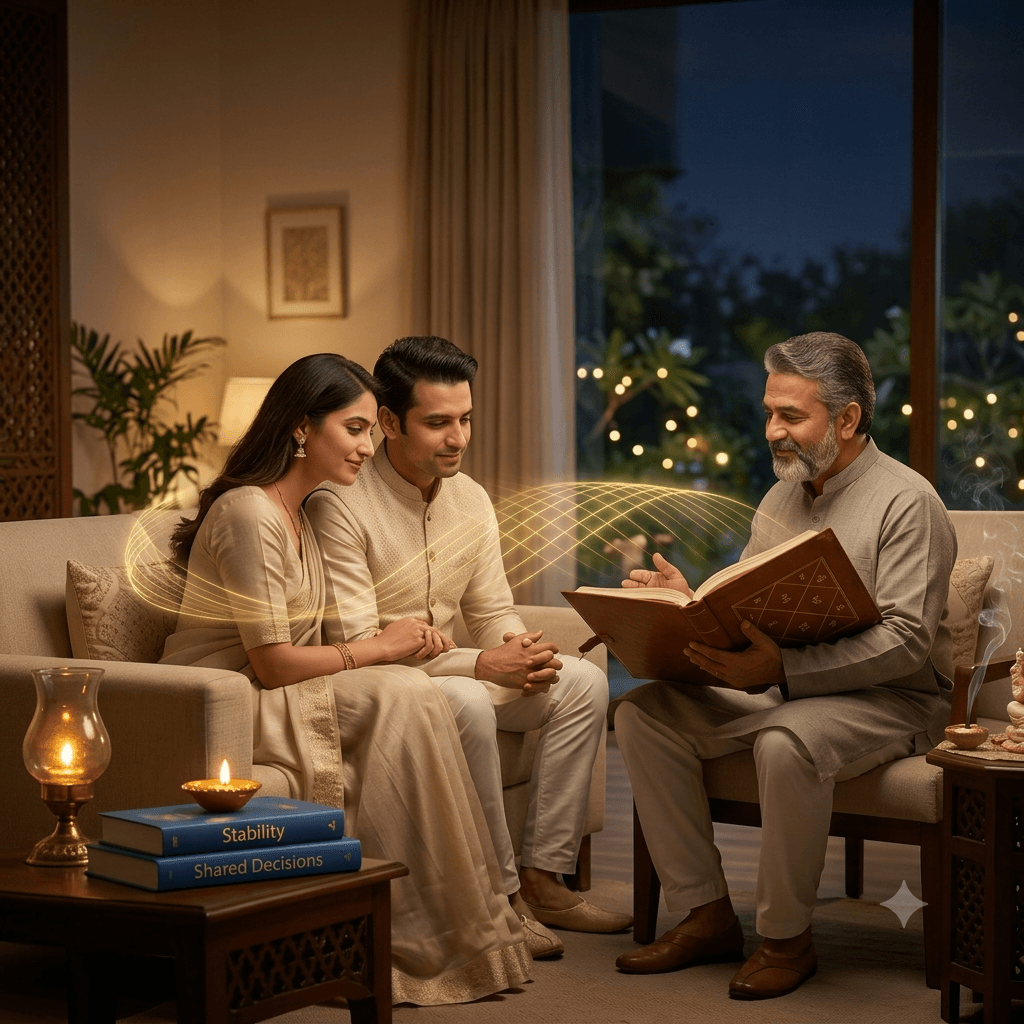
A consultation offers a respectful place to talk about what each of you believes and needs. If you both wish, a Kundli reading can be included as a traditional perspective. Nobody's belief is to be argued away; the aim is an arrangement in which both feel respected.
Identify the practices that are essential and those that are flexible. They are rarely all equally important.
Agree which occasions the less observant partner will attend, and which the other will keep alone.
Talk early about marriage rites, the home and children, so decisions are not made under pressure.
Each of you could note which practices are most important to you and why. The main service page explains how sessions work and the optional chart reading.
How the consultation worksEach says how the other's attitude comes across. Often no judgement was intended.
Decide together what you will do when relatives visit, and present it as a joint choice.
People's beliefs may shift, but planning on it is unfair. Work with how things are now.
Begin by asking your partner what their practice, or their distance from it, means to them. Listen without trying to persuade. Understanding the meaning behind it makes compromise possible. Then discuss specific occasions: which you will share, which you will keep separately, and how each can support the other.
Talk about the future before it arrives. Wedding ceremonies, festivals at home and the upbringing of children all need agreement. You may find creative answers, or you may find a real difference in what you want. Either way it is better known. No one should be pressured or forced into a practice or out of one.
The consultation is online and can be joined from anywhere in Jammu and Kashmir. We approach the subject without taking sides. Birth details are needed only if you would like a Kundli reading.
Many do, where there is mutual respect and clear agreement about shared occasions.
That is your choice. Some join in out of respect; others do not. Explain your reasons kindly.
Discuss it well before it arises. Couples find many arrangements; what matters is that you agree.
No. It is offered as a traditional perspective for those who want it, and is entirely optional.